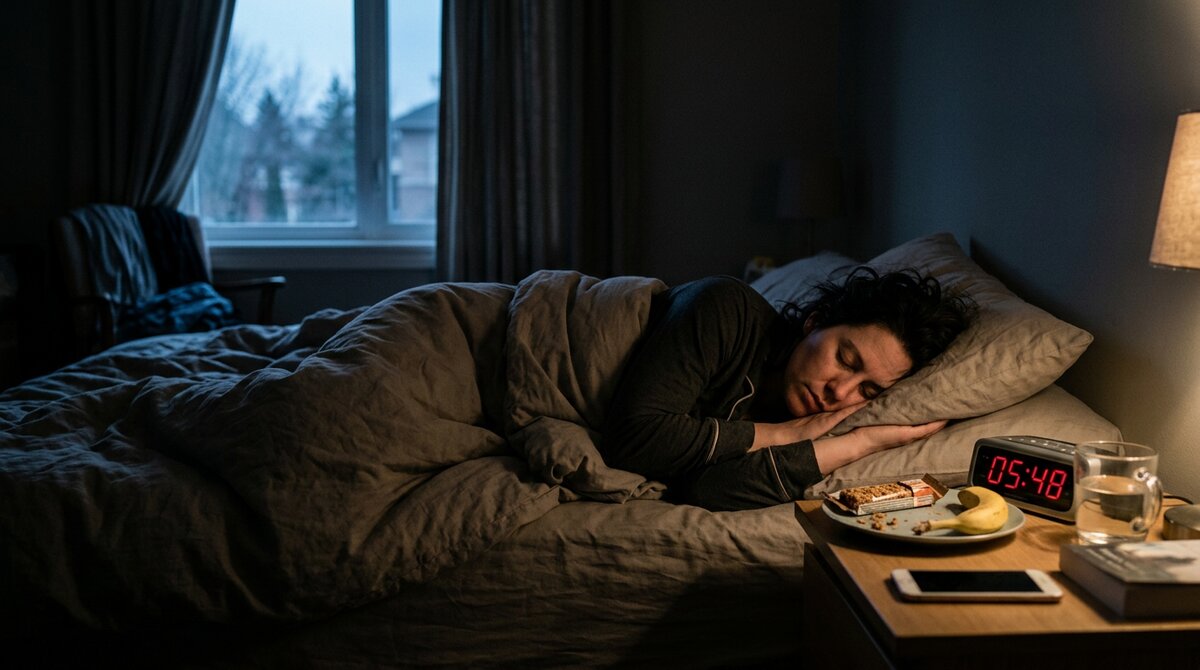
You stay up late, sleep five hours, and the next day you feel hungrier, foggier and a little more drawn to snacks. Is your metabolism "broken"? Not exactly. The best experimental evidence suggests that short sleep mostly changes how much you eat, not how many calories your body burns at rest. That distinction matters if you use a BMR and calorie calculator to plan your intake.
This article is educational and is not medical advice. If you suspect a sleep disorder or a thyroid or metabolic condition, talk to a qualified clinician.
The short answer
- In a 14-day inpatient Mayo Clinic study, sleep restriction increased calorie intake but did not change energy expenditure.
- Short sleep raised hunger signals in a University of Chicago study: ghrelin rose 28% and leptin fell 18% after two nights.
- During a calorie deficit, less sleep shifted weight loss away from fat and tow
Covassin and colleagues (2022) ran a randomized, controlled, crossover study with 12 healthy, non-obese adults, 9 of them male, aged 19 to 39. Over a 21-day inpatient stay, participants spent 14 days with either a 4-hour sleep opportunity or a 9-hour control opportunity, with free access to food. With sleep restriction, participants consumed more calories, with higher protein and fat intake. Energy expenditure was unchanged. They also gained more weight, and abdominal fat, including visceral fat, increased only during sleep restriction. The authors concluded that sleep restriction with ad libitum food promotes excess energy intake without changing energy expenditure.
That is a small study, and the sleep restriction (4 hours) was severe. But the design, inpatient and controlled, is the kind that is hard to get from surveys.
University of Chicago: the hunger hormones
Spiegel and colleagues (2004) studied 12 healthy young men under controlled calorie intake and activity. After two days of sleep restriction compared with two days of sleep extension, average leptin fell 18% and ghrelin rose 28%. Hunger rose 24% and appetite 23%, especially for calorie-dense, high-carbohydrate foods, where the increase was 33% to 45%. The authors noted the study was small, included only young men, and did not measure energy expenditure.
Sleep and dieting: what you lose matters
Nedeltcheva and colleagues (2010) studied 10 overweight adults on 14 days of moderate calorie restriction, once with an 8.5-hour sleep opportunity and once with 5.5 hours. With less sleep, the share of weight lost as fat fell by 55% (1.4 kg versus 0.6 kg), while loss of fat-free body mass rose by 60% (1.5 kg versus 2.4 kg). Participants also reported more hunger and showed a shift toward burning less fat. The authors concluded that insufficient sleep may compromise the efficacy of typical dietary interventions.
The scale may show the same number, but the composition behind it can differ. This echoes what we covered in metabolic adaptation, where dieting changes more than the arithmetic suggests.
Summary table: where sleep loss shows up
Part of energy balance What the studies above found Practical meaning ard fat-free mass. - Your calculated BMR does not drop because you slept badly. Your appetite, food choices and energy to move are what shift.
What BMR actually measures
Basal metabolic rate is the energy your body uses at complete rest to keep you alive: breathing, circulation, temperature control and cell maintenance. The Cleveland Clinic describes it as the minimum number o
Resting energy expenditure (BMR) No significant change in the Mayo inpatient study Do not lower your calculated BMR after a bad night Appetite hormones Leptin down 18%, ghrelin up 28% after two short nights Expect stronger cravings Calorie intake Higher with free access to food, including more fat and protein Easier to overshoot your target Body composition during a diet Less fat lost and more fat-free mass lost with short sleep Protect sleep while cutting Abdominal fat Increased with sleep restriction Chronic short sleep is a risk factor, not a certainty Worked examples with the Mifflin-St Jeor equation
The Mifflin-St Jeor equation estimates BMR as 10 x weight (kg) + 6.25 x height (cm) - 5 x age (years), then + 5 for men or - 161 for women. Here are two examples. They are estimates, not measurements. For how accurate they are, read why your BMR calculator might be wrong.
Example 1: a 35-year-old man, 80 kg, 178 cm
BMR = 10 x 80 + 6.25 x 178 - 5 x 35 + 5 = 800 + 1,112.5 - 175 + 5 = 1,742.5, or about 1,743 kcal per day. With a lightly active multiplier of 1.375, TDEE is about 2,396 kcal. Sleeping 5 hours a night does not change that 1,743 figure. But if short sleep makes you eat an extra 250 kcal a day without noticing, you move from roughly maintenance to a surplus of about 250 kcal. That figure is purely illustrative, not from the studies.
Example 2: a 32-year-old woman, 65 kg, 165 cm
BMR = 10 x 65 + 6.25 x 165 - 5 x 32 - 161 = 650 + 1,031.25 - 160 - 161 = 1,360.25, or about 1,360 kcal per day. At a moderately active multiplier of 1.55, TDEE is about 2,108 kcal. If she aims for a 400 kcal deficit, that is a target of about 1,708 kcal. On a short-sleep week, hunger and cravings make that target harder to hold, which is what the hormone data suggest. Her calculation is the same; her adherence is what changes.
f calories your body needs to function at rest. Most daily energy use is BMR, with the rest coming from food digestion and movement. If you want the full breakdown, see our guide on how to calculate BMR step by step.Total daily energy expenditure (TDEE) is BMR plus the thermic effect of food plus activity. Sleep loss could in theo
To run your own numbers, use the BMR and calorie calculator, and review our guide to TDEE activity multipliers to pick the right one.
Why tired days often mean fewer calories burned anyway
Even if resting expenditure is steady, daily movement can fall. After a poor night many people take fewer steps, skip workouts and sit more. That non-exercise activity is a large and flexible part of TDEE. We explain this in NEAT and daily steps. The Mayo study measured energy expenditure directly and found no significant change under controlled inpatient conditions, so do not assume a large drop. Instead, notice your own pattern for a week or two.
How to protect your calorie plan when sleep is short
Plan for the hunger, not against it
Since the main effect is on appetite, make food decisions before you are tired. Keep protein and fibre-rich foods ready, and avoid shopping or ordering when you are sleep-deprived.
Do not cut calories harder to compensate
A deeper deficit on top of poor sleep is the combination tested by Nedeltcheva: it shifted losses away from fat. Keep deficits moderate. Our article on eating below your BMR explains why aggressive cuts backfire.
Keep strength training and protein steady
Because fat-free mass was the casualty when sleep and calories were both low, resistance training and adequate protein are sensible safeguards. See how much protein you need per day.
Treat sleep as part of the plan
Most health bodies suggest adults aim for at least seven hours of sleep. Treating sleep as a scheduled habit, like meals or training, is a low-cost way to support everything else.
Frequently asked questions
Does lack of sleep slow your metabolism?
ry touch any of these parts, so it helps to look at each one separately.What the research found
Mayo Clinic: more food, same expenditure
In the Mayo Clinic inpatient study, energy expenditure did not change significantly with two weeks of 4-hour sleep. The bigger effect was on how much participants ate. Other effects on hormones and fat distribution are real, but a big drop in BMR was not what that study found.
Does sleep deprivation make you burn fewer calories?
Not by much in controlled testing. You may burn fewer calories in daily life if tiredness reduces your movement, but that is a behavior change rather than a change in BMR.
Why am I so hungry when I sleep badly?
Spiegel and colleagues found that two nights of restricted sleep lowered leptin by 18% and raised ghrelin by 28%, with hunger up 24%. Those hormone shifts are a plausible reason for the cravings.
Can I lose weight if I only sleep five hours?
Possibly, but the evidence suggests it may be less efficient. In the 2010 study, short sleep reduced the proportion of weight lost as fat by 55% during the same calorie restriction. Results from 10 people are limited, so treat it as a signal, not a rule.
Should I change my BMR calculation after a bad night?
No. A BMR estimate is based on weight, height, age and sex. A single night does not change those inputs, and the research does not support adjusting it downward.
Can catching up on sleep fix it?
The studies above did not test long-term recovery in detail, so no firm promise is possible. Regular, sufficient sleep is a sensible foundation either way.
Bottom line
Short sleep is less about a "slow metabolism" and more about a louder appetite, weaker diet results and possibly more abdominal fat over time. Keep your calculated BMR and TDEE as they are, plan for stronger hunger, keep deficits moderate, and protect your sleep. Then use the BMR and calorie calculator to set a realistic daily target.
Sources
- Covassin N, et al. Effects of Experimental Sleep Restriction on Energy Intake, Energy Expenditure, and Visceral Obesity. J Am Coll Cardiol. 2022;79(13):1254-1265. PMID 35361348.
- Spiegel K, et al. Brief communication: Sleep curtailment in healthy young men is associated with decreased leptin levels, elevated ghrelin levels, and increased hunger and appetite. Ann Intern Med. 2004;141(11). PMID 15583226.
- Nedeltcheva AV, et al. Insufficient sleep undermines dietary efforts to reduce adiposity. Ann Intern Med. 2010;153(7):435-441. PMID 20921542.
- Cleveland Clinic. Basal Metabolic Rate (BMR). my.clevelandclinic.org/health/body/basal-metabolic-rate-bmr
Comments
Post a Comment